
Key Lessons from Product Camp 2025 by OPMMA for AI-Driven Digital Product Teams
13 June 2025 2025-06-13 15:57Key Lessons from Product Camp 2025 by OPMMA for AI-Driven Digital Product Teams
Key Lessons from Product Camp 2025 by OPMMA for AI-Driven Digital Product Teams
 msohanh
 Disclaimer: ChatGPT was used to modify the article after the first draft, but the blog’s written based on my notes and views, and reviewed thoroughly.
Introduction
I had the opportunity to attend Product Camp 2025, the first product camp I had been to. It was an epic experience for me where I spent most of the time trying to absorb the quality information being shared by distinguished professionals. It was a fresh change of environment because this is the first time I was in a room full of AI practitioners, leaders, and enthusiasts.
This was not the usual “Ooh, ChatGPT can do this!,” or, “AI is evil” or “We should do something about AI” crowd. There were experts who have deeply explored AI, are mindful about its impact, and are hopeful about the future of AI. Not that there’s anything wrong with having opinions about AI or with using only the simple use cases of ChatGPT and other tools.
But it felt less like being a passenger waiting for lunch on the flight to ‘AI Land’, and more like getting to see the cockpit, or getting shown how the dashboard works, or discussing how the engine works, or discussing the ways it might fail. As an AI enthusiast, that hands-on perspective was both refreshing and encouraging.
Panel Discussion Highlights
The panel discussion, titled, “AI-Powered Software Products: Innovating at Scale,” focused on an overview of how AI is impacting the workflow and strategy of the panelist’s organizations. It was moderated by Nick Quain, VP of Invest Ottawa, and the panelists involved Leah McGuire, SVP of Customer Success & Operations at LearnExperts, Aydin Mirzaee CEO of Fellow.ai, Hawley Kane Head of Marketing at LemonadeLXP.
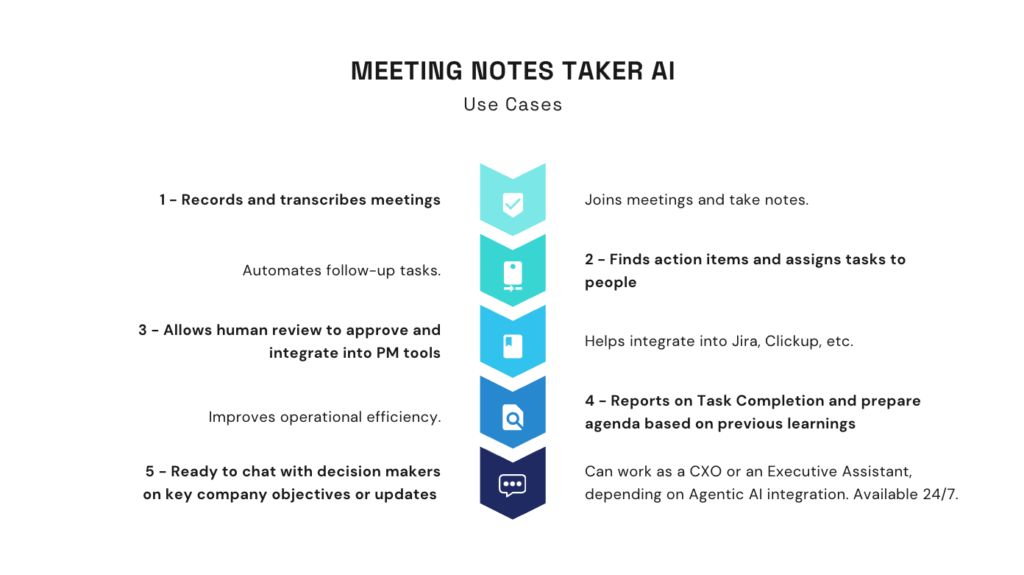
AI is More than a Note-Taker
The story of how Fellow pivoted from a meeting notes taker to an organizational AI-powered Knowledge Management tool (among other value props) made it clear that AI note takers are here to stay.
Understanding User Types for an AI Productivity App Adoption
- Approximately only 15% of users are naturally organized, and 85% like to work in multiple creative ways.
- Strategy: Build products appealing enough to organized users who naturally attract others through peer influence.
- Opportunity: Investigate root causes behind user disorganization and proactively design intuitive, supportive features.
A Curious Thought – Are Robots a Good Symbol for AI?
One of the speakers remarked that AI is often still associated with “robots,” but is it only limited to that? I found that a great question, because robots symbolize a tool that performs mechanical, instruction-oriented activities. Yes, an AI can be placed in the software to run the robot, but if AI is about creating an intelligence which represents the best parts of human intelligence, then what can we use to symbolize it?
Compliance Awareness – Expect Slow Growth to be Fully Compliant
- Compliance processes like HIPAA, PIPEDA, SOC2, etc. could typically require at least 6 months for mid-sized and large enterprises.
- Implication: Prepare for longer sales cycles when approaching mid or large companies, and ensure product designs comply early with regulatory frameworks.
- Small businesses especially seek immediate, understandable AI benefits, emphasizing workflow simplicity.
- When a user truly understands the impact AI could have, they “are ready to present their credit card to buy.”
Breakout Session Insights
I attended the following sessions:
| Speaker | Topic |
|---|---|
| Pauline Kabitsis | Unlocking product growth with behavioral science: Why your users don’t do what you expect |
| Mark Levison | AI For Product Backlog Management |
| Joe Thibault | Product Discovery Done Right: Building the right thing starts with asking the right questions |
| Dan Barkley | Think strategically, Act systematically: Positioning you and your product for success |
There were lessons emerging in an inter-connected manner, for example, what I learned in one session was sometimes being refined by another session’s lessons. So, I avoided crediting speakers specifically.
There were also lightning round sessions covering a wide range of subjects centred on the topic – Everyday AI Tools for Product Leaders. The following speakers gave a 6-minute speech on specific areas: Joe (Beiqiao) Hu, Valentyna Akulova, Deena S. Ramsaran, Arina Spiridonova, and Sergii Gudkov. The session was moderated by Amanda Holtstrom.
Core Systems and AI Tools
- AI fundamentally serves as a powerful pattern-matching tool rather than being a tool with “intelligent” creativity.
- Theory of Constraints: Every system contains a bottleneck—identifying and optimizing this point yields the greatest efficiency improvements. For instance, QA teams’ testing practices often constitute major bottlenecks.
- AI solutions can significantly improve flow at these bottlenecks, surpassing the efficiency of purely human-managed processes.
Simplicity versus Complexity
- Complex systems fail without robust constraints and simplicity. AI implementations should strive for simplicity, reducing complexity to manage risks effectively.
Behavioral Change: Cognitive Science Applications
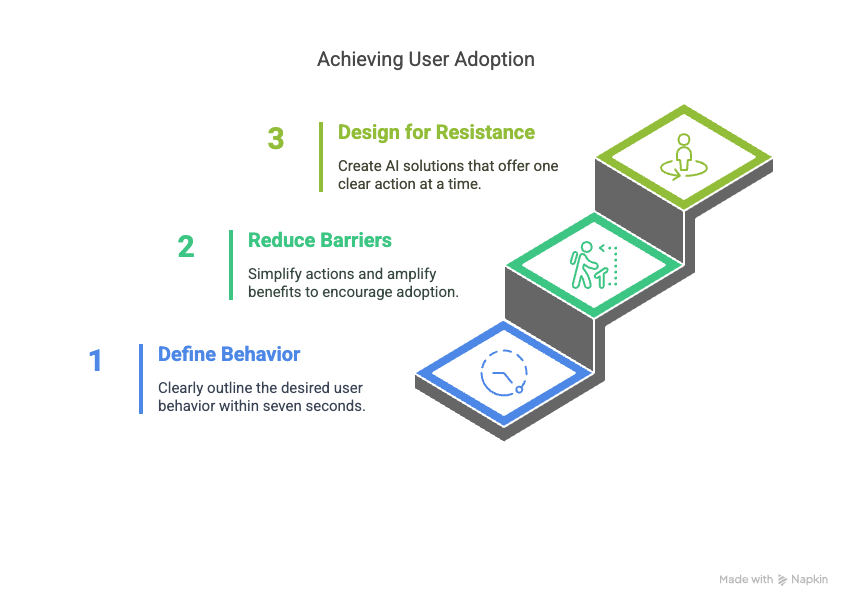
3B Framework (Behavior, Barriers, Benefits)
- Clearly define the desired user behavior within seven seconds or less, ensuring it’s measurable and observable.
- Reduce barriers to make actions easier and amplify the benefits to encourage adoption.
- Clearly demonstrate benefits.
Humans naturally follow the path of least resistance—design AI solutions accordingly, offering one clear action at a time.
Building Buy-In for AI Projects
Practical Buy-In Tactics:
AI has made it much simpler to:
- Use quantitative, numbers-based presentations to demonstrate value.
- Share wireframes, mockups, and interactive prototypes to visually demonstrate capabilities.
- Employ live demos and proof-of-concept models to build trust and confidence.
During one of the sessions, I learned about the UI/UX tool Galileo AI, which immediately served a business need and helped drive a client from awareness to consideration phase. In the following weeks, Galileo AI got acquired by Google. And on a separate note, I closed the client. While writing the blog I realized without me going to Product Camp Ottawa 2025, I don’t know how long it would have taken me to solve those two problems.
Product Architecture & Prioritization:
- Allocate efforts strategically: 30% Core features, 60% Competitive features, 10% Contender experimental ideas.
- Focus intensively on testing and monitoring to ensure feature reliability and user acceptance.
This lesson has helped me guide my team at AI Buddy Learning Lab.
Product Discovery: Best Practices
Customer-Centric Discovery
- Engage customers through direct, qualitative questions:
- “Tell me about a time you faced this problem?”
- “Why is this feature essential to you?”
- “What service/software would you stop paying for to adopt ours?”
Validation and Prioritization
- Not all good ideas need immediate development.
- Prioritize experimentation, gather feedback with minimal resources, validate demand, then proceed to full-scale development.
Recommended Tools & Methodologies:
- Frameworks like Jobs-to-be-Done, Empathy Maps, Journey Maps, Kano Model.
- Regular, structured conversations across sales, tech, and marketing teams to surface and validate user needs early.
Growth, Positioning, and Analytics-Based Innovation
Effective GTM and Positioning Strategies
- Communicate clear, immediate value and minimize perceived complexity.
- Early adopters prioritize clarity over sophisticated features—simplify your messaging accordingly.
Innovation Tracking
- Integrate analytics in product discovery to understand which ideas, biases, and assumptions hold true and where adjustments are required.
- Implement guardrails and bias-correcting mechanisms based on analytics insights.
Recommended Reading
- “Innovation Games” was highly recommended by Mark Levison (whose session I thoroughly enjoyed), for deeper discovery and innovation management strategies.
Summary of Actionable Lessons
| Area | Action |
|---|---|
| Design | Build initially for the organized user; leverage viral growth. |
| Development | Identify bottlenecks and leverage AI automation. |
| Marketing | Focus messaging on simplicity, emotional connection, and clear productivity outcomes. |
| Strategy | Prioritize ruthlessly—validate extensively before development. |
| Collaboration | Strengthen alignment across product, sales, tech, and marketing teams from the project’s inception. |
Legal and Ethical Considerations
- Address copyright issues proactively, especially regarding AI-generated content.
- Manage privacy and data security meticulously—maintain confidentiality and ensure compliance with global standards (e.g., GDPR).
- Clearly delineate authorship between AI and humans to avoid ethical and reputational pitfalls.
- Combat misinformation and liability risks with thorough content verification and human oversight.
- Monitor AI biases continuously, implement measures to mitigate discrimination, and maintain ethical integrity in AI applicationsLegal Issues.
Conclusion
“Leveraging insights from the Product Camp event, coupled with a clear understanding of our ICP, provides strategic direction for enhancing AI-driven digital product creation and operational efficiency. By emphasizing behavioral insights, systematic bottleneck management, collaborative discovery, and strong ethical practices, we position ourselves to maximize growth, user adoption, and long-term impact.” – ChatGPT, when asked for a conclusion on the write-up.
It had written “from the Product Hunt event”, haha.
As a human writing this, I would say this event left me wishing for more such events. It was very inspiring and useful; I ended up solving multiple work-related problems that day and in the upcoming days. But above all, it felt great to be part of a community.
I’m grateful to the Ottawa Product Marketing and Management Association (OPMMA) team for organizing this event. I think such day-long, immersive events are vital to sustaining the momentum of the tech community as the digital disruption continues. I hope the local sponsors and community leaders see the value and the network effect potential and support more events like the Ottawa ProductCamp 2025.