
Ethical Considerations of Content Creation with AI 2025
16 January 2025 2025-05-01 15:14Ethical Considerations of Content Creation with AI 2025
Ethical Considerations of Content Creation with AI 2025
 msohanh
 [Disclaimer: AI tools were used to write this blog, which was then reviewed by two professionals whose work involves digital marketing and content creation including the author. This document will be updated in future, you are reading the 1st version.]
Remember J.A.R.V.I.S., Tony Stark’s famous AI assistant in Iron Man? That’s where we are in 2025—Artificial intelligence (AI) is our J.A.R.V.I.S. AI is a smart and powerful assistant that helps us craft texts, generate visuals, offer analytics insights, and even compose music and animations. Generative AI tools like ChatGPT have revolutionized content creation, enabling faster workflows and unlocking new creative dimensions. But, as Uncle Ben in the Spider-Man film says, “With great power comes great responsibility.”
(Fun fact – JARVIS was used as the name of an AI company who had to painstakingly change their name to Jasper AI, and I have taken Jasper’s help to write this blog)
Even though it is a quote of the uncle of an imaginary super hero, it contains a message of significant importance. While AI seems to be the perfect virtual assistant, the lines can get blurry when it comes to ethical concerns. When using AI, businesses grapple with questions like “What happens if an AI tool makes a biased statement?”, “How do we ensure the trustworthiness in an AI-generated content?”, “How does using AI impact my employees’ attitude towards the company?”, or, “Am I violating any ethical norms that can negatively hurt my branding and business?”
In this blog called Ethical Considerations of Content Creation with AI 2025, let’s explore the key ethical concerns that surround AI-based content creation and how businesses can address them effectively.
Key Ethical Concerns Surrounding Content Creation in AI 2025
1. Bias in Content
AI models are trained using vast datasets sourced from the internet. This means they weren’t built from scratch, but instead inherit biases from the data they consume. It’s similar to the prodigal student portrayed by Matt Damon’s character in Good Will Hunting’s, who is brilliant but makes the wrong decisions in life because of internal struggles. When AI generates content with gender or racial bias, it doesn’t only damage society but risks branding and financial harm to businesses.
For example, In 2023, Buzzfeed’s “Barbies of the World” project generated culturally insensitive AI images, such as a German Barbie in a Nazi uniform and a South Sudanese Barbie with a gun, showcasing deep algorithmic biases.

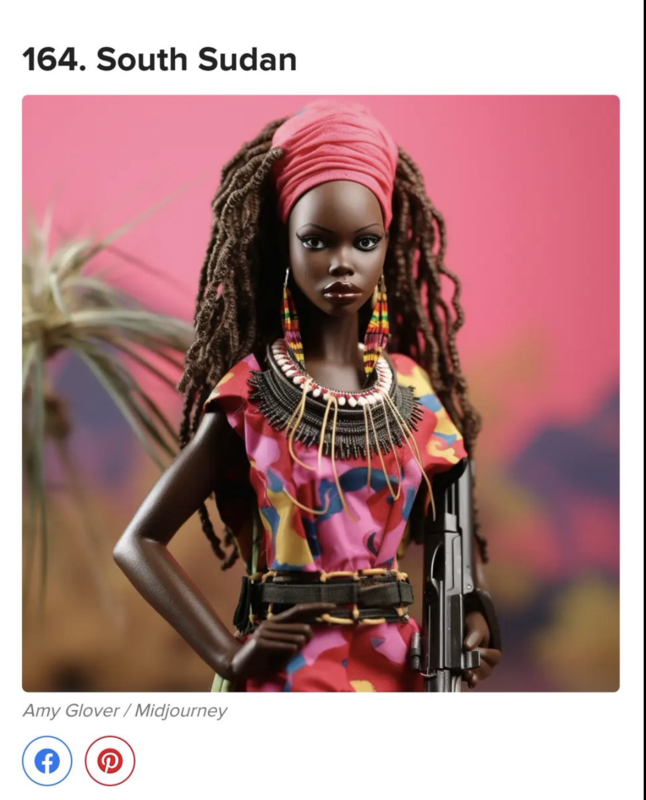
Therefore, users of AI in content creation 2025 should be smart and sensitive to make AI-generated content more equitable and fair. Using diverse and representative datasets can help reduce biases and promote inclusivity.
2. Misinformation and Misuse
With the ability to bend reality with deep fake content, whether in the form of audio, image, or video, creating “fake news” has become a lot easier. As a result, it has become extremely important for educators who are teaching AI Content Creation to be mindful about who they are teaching and what they are teaching.
To avoid the widespread of misinformation, it has become extremely important for educators who are teaching AI Content Creation to be mindful about who they are teaching and what they are teaching.
AI deepfakes were used to create fake audio clips of a politician in Slovakia discussing vote rigging, misleading voters during the 2024 elections.
Content creation in AI 2025 should, therefore, be done with caution and mindfulness to safeguard accuracy and address malicious misuse. Without boundaries, content creators risk becoming unwilling emissaries of digital harm.

A Samurai in Toronto imagined by AI. For someone who doesn’t know what Toronto looks like, what a Samurai is, and who cannot identify digital image from real image by using their observation skills, this image can create confusion about reality. This is why AI generated content must be labeled properly.
3. Job Displacement from AI Adoption
Another danger of using Content Creation AI tools is that it can reduce manpower and lower overhead. When this happens, AI can easily steal jobs and opportunities for human talent, which can eventually invite unnecessary resistance to learning and implementing AI.
British Telecom announced plans in 2024 to replace 10,000 employees with AI over seven years, leading to concerns about workforce reductions.
It is difficult to predict what would happen to such employees and such mass layoffs a massive problem for governments because the rise of unemployment is directly proportionate to the crime rate of a nation. One clear action step is to draft and implement policies that serve the interests of the parties involved and draw a win-win during this technological transition into the economy and the labor force.
4. AI-Driven Plagiarism
Pre-AI, plagiarism was already a serious ethical problem among creatives, professionals, academics, content creators, and other innovators. Now that AI tools have become popular among students, the risk has become even bigger and more significant.
A Study.com research surveying over 100 educators and over 1,000 students found 89% of students admitting to use ChatGPT for homework, highlighting its extensive adoption for academic tasks. The survey also found that 43% of students in higher education use AI-powered tools to enhance their learning, such as for personalized study recommendations or clarifying complex concepts.
It is to be noted that the survey details do not mention the students’ ethnographic or demographic information. But it could be assumed that most of the participants had access to internet, a device to access it, and know use cases of how to use a computer for study purposes. The results would vary if students of the underdeveloped nations also participated in large numbers. However, the case still holds that in developed nations, ChatGPT is being widely used by undergraduate and post-graduate students. From my experience as an MBA Student at the University of Ottawa, it was evident.
Plagiarism with AI is also happening in professional circles. CNET faced backlash in 2023 after its AI-generated articles were found to plagiarize content from competitors and human writers without attribution. Source.
We are stepping into the age of “AIgiarism”—plagiarism authored by the machine, and surely it needs to be avoided if we want to save human creativity. This extends to intellectual property concerns, with questions swirling about who really owns content generated by AI. Are prompts enough for authorship, or does the credit lie with AI developers? Legal frameworks have yet to catch up with this new landscape.
5. Security Risks
AI’s brilliance is a double-edged sword. Hackers using AI for attacks are now nearly undetectable. AI-powered spear-phishing attacks or the storage and misuse of sensitive data are major security risks AI developers and users must address.
In May 2023, Samsung employees accidentally leaked sensitive internal data by using ChatGPT for code review, prompting the company to ban generative AI tools.
People who have been scammed by telephone calls or have heard of such stories can find it troublesome when they are asked to imagine how such scammers can exponentially increase their outreach with AI agents that can talk, research, and persuade.
Call to Action: Collaborating for Ethical AI in Content Creation
The way to avoid serious ethical issues surrounding content creation in AI 2025—and beyond—is through human collaboration. Think of it as assembling the Avengers of AI development. Developers, regulators, businesses, academicians, professionals, and any other users – we all a role to play. Together, we need to prioritize diverse datasets, establish regulatory guardrails to ensure a peaceful and prosperous transition, and raise awareness of responsible AI use.
Let us empower content creators to see AI as a tool to enhance their work or product, not as a shortcut that compromises ethics, originality, or quality.
For instance, organizations such as the Partnership on Artificial Intelligence and the Center for Democracy & Technology have already outlined ethical guidelines. Governments are also stepping up, with frameworks like the US AI Bill of Rights and the European Union’s Trustworthy AI Guidelines. Now, it’s up to businesses and creatives to work within these frameworks and adapt them to their ecosystems.
AI and Content Creation: What the Future Holds
AI is evolving at a shockingly fast pace, and if you don’t embrace its features and power, you will be left behind. Here’s what we predict for the trajectory of AI in content creation 2025 and in the coming years:
- Mainstream Adoption: AI will become the de facto tool for content creation, but businesses that prioritize ethical frameworks will have a competitive edge.
- Enhanced Transparency: Clear labeling of AI-generated content will become the industry standard, building trust with consumers.
- Stronger Accountability: Regulatory bodies will clamp down on unethical practices to hold developers and users accountable for misuse.
Just as Steve Jobs knew technology could “put a dent in the universe,” ethical AI content creators will create a huge difference in shaping the industry—and society—for the better. And going back to Mr. Job’s choice of words, no one likes a dent on their shiny car. By treating AI as a tool that enhances rather than replaces, content creators, marketers, and other users of AI can champion a visionary ethical approach that benefits every stakeholder involved.
Bonus:
Practical Ethical Guidelines for Content Creators
Cool tech alone is never enough. Here’s how creators, marketers, and innovators can ensure their AI initiatives are ethical:
- Fact-Check with Extreme Caution: Always validate AI outputs using trustworthy sources to avoid inaccuracies.
- Be Transparent and Honest: Disclose when content is AI-generated to build trust with your audience.
- Don’t Over-Rely: Lean into AI as an enhancer, not a replacement. Allow human intuition and judgment to guide final outputs.
- Train Responsibly: Use inclusive, diverse, and unbiased datasets for better content and less harm.
- Protect Privacy: Avoid disclosing sensitive information to AI tools to mitigate risks like data theft or accidental leaks.
By following these steps, businesses can balance the electricity of innovation with the ethical integrity that audiences, employees, and stakeholders demand in a connected world.
1 InData Labs
2 SEO.ai Blog
3 Futurism
4 Prompt Security Blog
5 PBS NewsHour
6 Malwarebytes
Appendix
The process of writing this blog involved individual research, research with Perplexity AI, planning and structuring with ChatGPT, first draft creation with Jasper AI, and human review by two contributors including the author.